One of the most important things anyone can understand about addiction is this — it is not a choice, a character flaw, or a sign of weakness. Addiction is a chronic brain disorder that physically changes the structure and function of the brain over time. Understanding exactly what happens to your brain during addiction explains why stopping is so difficult, why willpower alone rarely works, and why professional treatment is so effective. This guide explains the science in plain language — no jargon, no complexity, just a clear picture of what addiction actually does to the human brain.
✓ Evidence based
✓ No medical jargon
✓ Covers recovery too
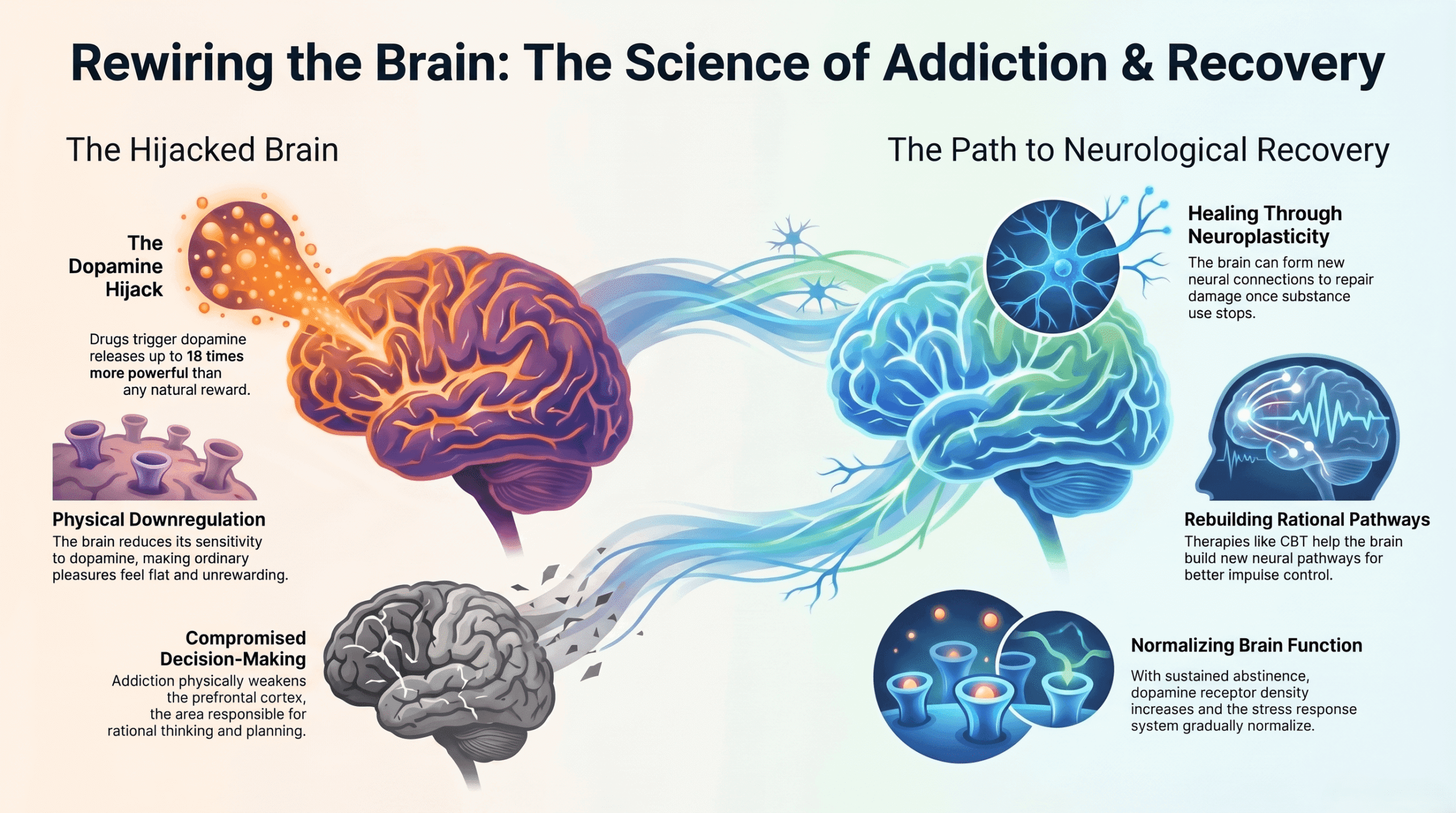
The Brain Before Addiction — How the Reward System Works
To understand what addiction does to the brain you first need to understand how the brain’s reward system works normally. The brain has a built-in reward circuit designed to motivate survival behaviors like eating, drinking water, and connecting with other people. When you do something that helps you survive or feel good, your brain releases a chemical called dopamine into a region called the nucleus accumbens — often called the brain’s pleasure center. This dopamine release creates a feeling of pleasure and satisfaction and signals to your brain — remember this, do it again. This is a healthy and necessary system. It motivates you to repeat behaviors that are good for you.
The problem begins when drugs or alcohol hijack this system completely.
Step 1 — The Hijack: How Drugs Flood the Brain With Dopamine
Every addictive substance works differently in the body but they all share one common feature — they flood the brain’s reward system with far more dopamine than any natural experience ever could. A meal might cause a moderate dopamine release. Spending time with someone you love produces a warm, satisfying dopamine response. But heroin, cocaine, methamphetamine, and alcohol trigger dopamine releases that are anywhere from 2 to 10 times more powerful than any natural reward. The brain has simply never experienced anything like it. The pleasure is intense, immediate, and overwhelming. The brain registers this as the most important thing that has ever happened — and begins the process of making sure it happens again.
Step 2 — The Adaptation: Why the Brain Turns Down Its Own Pleasure
The brain is an adaptive organ. When it detects that something is flooding it with far too much dopamine it responds by reducing its own sensitivity to dopamine in two ways — it produces less dopamine naturally and it reduces the number of dopamine receptors available to receive it. This process is called downregulation and it is the beginning of physical dependence. The consequence is profound — ordinary pleasures that used to feel good no longer produce much dopamine response at all. Food, relationships, hobbies, exercise — activities that used to bring genuine joy now feel flat, empty, and unrewarding. The only thing that produces anything close to a normal feeling of pleasure is the substance itself. This is why people in active addiction often describe feeling nothing except when they are using — their brain has literally reduced its capacity to feel pleasure from anything else.
Step 3 — Tolerance: Why More Is Never Enough
As the brain continues to downregulate its dopamine system in response to ongoing substance use, the same dose of the substance no longer produces the same effect. The person needs more of the substance to achieve the same feeling they got before — this is called tolerance. Tolerance is not a sign of weakness or excess. It is a measurable, predictable neurological response to repeated drug exposure. The brain keeps adapting downward and the person keeps increasing their dose to compensate. This cycle of escalating use and deepening tolerance is one of the defining features of addiction and explains why people who start with small amounts often end up using quantities that would have been unimaginable to them at the beginning.
Step 4 — Withdrawal: What Happens When the Substance Is Removed
When a person who has developed physical dependence stops using a substance abruptly the brain is suddenly deprived of the only thing that has been triggering any meaningful dopamine response. The result is withdrawal — a collection of intensely unpleasant physical and psychological symptoms that vary depending on the substance but can include severe anxiety, depression, insomnia, nausea, vomiting, muscle cramps, sweating, tremors, and in the case of alcohol and benzodiazepines, life-threatening seizures. Withdrawal is not a punishment for bad behavior — it is the predictable neurological consequence of the brain trying to function without a substance it has adapted to depend on. This is why medically supervised detox is so important — withdrawal from certain substances can be genuinely dangerous without proper medical support.
Step 5 — The Craving Circuit: How Addiction Rewires Decision Making
Beyond the reward system, addiction also physically changes three other critical brain regions that control behavior, decision making, and impulse control. The prefrontal cortex — the part of the brain responsible for rational thinking, planning, weighing consequences, and making decisions — becomes less active in people with addiction. This is not metaphorical. Brain imaging studies consistently show reduced activity and even physical changes in the prefrontal cortex of people with substance use disorders. This reduction in prefrontal activity explains why people with addiction make decisions that seem irrational to outside observers — their brain’s capacity for rational decision making has been physically compromised by the addiction. The amygdala — the brain’s stress and fear center — becomes hyperactive in addiction, generating powerful stress responses and negative emotions whenever the substance is not available. This creates a powerful negative reinforcement loop where using the substance becomes necessary not just to feel good but to escape overwhelming anxiety, discomfort, and psychological pain. The hippocampus — the brain’s memory center — encodes powerful memories of the pleasurable effects of the substance and the environmental cues associated with using it. These memories become deeply embedded and can trigger intense cravings even years after a person has stopped using — triggered by a smell, a place, a sound, or an emotion associated with past drug use. This is why cravings can feel so sudden and overwhelming even in long-term recovery.
Why Willpower Alone Rarely Works
Understanding these five neurological changes makes it clear why telling someone with addiction to simply choose to stop is as unhelpful as telling someone with a broken leg to choose to walk normally. The brain regions responsible for decision making have been physically compromised. The reward system has been fundamentally altered. Stress responses are dysregulated. Powerful environmental memories trigger cravings involuntarily. Stopping substance use requires the person to use the very brain systems that have been most damaged by the addiction. This is not an excuse — it is neuroscience. It is also the reason that effective treatment addresses these specific brain changes rather than simply relying on motivation and willpower.
Can the Brain Recover From Addiction?
Yes — and this is one of the most important and hopeful findings in addiction neuroscience. The brain has a remarkable capacity for recovery called neuroplasticity — the ability to form new neural connections and adapt its structure and function in response to new experiences. Research consistently shows that with sustained abstinence and appropriate treatment the brain begins to recover. Dopamine receptor density increases. Prefrontal cortex activity improves. The stress response system gradually normalizes. The timeline varies depending on the substance, the duration of use, and individual factors — some recovery happens within weeks of stopping, some takes months or years. But the scientific evidence is clear — the brain can and does heal from addiction with time and appropriate support.
How Treatment Helps the Brain Heal
Effective addiction treatment works by supporting the brain’s natural recovery process on multiple levels simultaneously. Medication assisted treatment (MAT) using medications like buprenorphine, naltrexone, and methadone directly addresses the neurochemical imbalances caused by opioid addiction — reducing cravings, normalizing dopamine function, and allowing the prefrontal cortex to regain function without the constant disruption of withdrawal and craving. Cognitive behavioral therapy (CBT) directly targets the prefrontal cortex — rebuilding the capacity for rational thinking, impulse control, and decision making that addiction has compromised. By practicing new thought patterns and behavioral responses in therapy, patients literally build new neural pathways that support recovery. Trauma therapy addresses the amygdala’s hyperactive stress response — processing the underlying trauma and emotional pain that drives substance use as a coping mechanism. Relapse prevention strategies work with the hippocampus — helping patients identify and manage the environmental triggers and cues that activate powerful substance-related memories and cravings. Exercise, nutrition, and mindfulness practices support overall brain health and accelerate the neuroplastic recovery process. Peer support and community connection restore the brain’s natural social reward system — gradually rebuilding the capacity to find genuine pleasure and meaning in human connection that addiction had suppressed.
What This Means for You or Someone You Love
If you or someone you love is struggling with addiction the most important thing this science tells us is that addiction is not a personal failing — it is a brain disorder that responds to treatment. The changes addiction makes to the brain are real, measurable, and significant. But they are also reversible with time, support, and appropriate care. Nobody chooses to have their brain rewired by addiction. And nobody has to face the process of recovery alone. If you are ready to take the first step browse our Florida free rehab directory for verified free and low cost treatment options near you, or call SAMHSA at 1-800-662-4357 — free, confidential, available 24 hours a day.
Frequently Asked Questions
Is addiction really a brain disease?
Does the brain go back to normal after addiction?
Why do cravings happen even after years of sobriety?
Why is withdrawal so painful and dangerous?
Can someone with addiction just choose to stop?
How does medication assisted treatment help the brain?
Further Reading
- → Signs someone you love is addicted — and what to do next
- → What is detox and do I need it?
- → Inpatient vs outpatient rehab — which is right for you?
- → How to get free rehab with no money or insurance
- → Free rehab centers in Florida — complete directory
Ready to Find Free Rehab Near You?
Browse our complete directory of free and low cost rehab centers across Florida or call SAMHSA at 1-800-662-4357 for free confidential guidance available 24 hours a day.

Rose Smith is a writer and editor with a passion for creating clear, informative, and engaging content. She specializes in health, wellness, addiction recovery, and lifestyle topics, helping readers make informed decisions through well-researched, easy-to-understand articles. With a strong editorial background and a commitment to accuracy, Rose focuses on producing trustworthy content that educates, inspires, and supports people seeking reliable information.